Colorado elopement permits are the least romantic part of planning the best day of your life, and the part most likely to trip you up if nobody explains it plainly. The rule that decides everything is not the location. It is the land manager. The same alpine basin can require a formal application, a quick phone call, or nothing at all depending on whether it sits inside a national park, a national forest, a state park, county open space, or Bureau of Land Management land. This guide walks through all of them, with fees and lead times checked against the official pages, so you can pick a spot and know exactly what it asks of you before you fall in love with a photograph of it.
This is the deep version of the permits section in our Colorado elopement guide. If you have not read that yet, start there for the full picture of licenses, timing, and locations, then come back here when you are ready to solve the paperwork for your specific place.
The One Question That Decides Everything
Before you look at a single fee, answer one question about your day: are you two people standing still with nothing set up, or are you building something? That single distinction, more than group size or location, is what most land managers care about first.
A two-person ceremony with no chairs, no arch, no amplified music, and no reserved space is the lightest footprint you can have. On a lot of public land it requires no permit at all, because you are legally indistinguishable from any two hikers who paused at an overlook. The moment you add structure, though, the calculus changes. An arch, seating, a sound system, a reserved block of space, or a guest list past a handful of people all signal an event, and events get permitted.
National parks are the exception to this logic. There, a wedding ceremony almost always needs a permit even for two people with nothing set up, because the ceremony itself is the trigger, not the equipment. Everywhere else, the setup is usually what tips you from casual use into permit territory. Keep that frame in mind as you read, because it is the thread running through every section below.
National Parks: Formal, Structured, and Worth the Paperwork
Colorado has four national park units where couples marry, and all of them follow the same federal logic: a wedding ceremony needs a Special Use Permit, even for the two of you. The permit protects the landscape and keeps one couple from stepping on another's ceremony at the same overlook. Each park runs its own application, fee, and calendar, and the popular ones fill fast.
Rocky Mountain National Park
RMNP is the most requested elopement location in the state and runs the most competitive permit calendar in the country. The Special Use Permit fee is $300, and a useful detail is that you do not pay it until after your application is approved. Your permit gives you one of the park's thirteen designated ceremony sites for a two-hour window, with per-site group caps that range from 15 to 30 people, counting you, your guests, and every vendor. Ceremonies anywhere other than a designated site are citable, so this is not a place to improvise.
The permit carries a real perk: it doubles as your timed-entry reservation for the whole day of your ceremony, so you skip the separate reservation scramble that ordinary visitors deal with in peak season. Applications open on the first of the month, one year in advance, which means a July 2027 date opens July 1, 2026. Summer sites sell out within days. Set a reminder for exactly one year ahead of your ceremony month and apply that morning. Everything about sites, seasons, and the application lives in our Rocky Mountain National Park elopement guide and on the official RMNP weddings page.
Great Sand Dunes National Park and Preserve
North America's tallest dunes against the snowcapped Sangre de Cristos, with a fraction of RMNP's competition. The permit fee is $200, and the timing is unusual: applications open January 1 of your ceremony year, so you cannot lock a date a full year out the way you can at RMNP. The upside is a short runway, with a seven-day minimum before your date, which makes this one of the more flexible parks in the Rockies. Ceremonies on the dunefield are capped at 15 people and require hiking through soft sand, while larger groups use the amphitheater. Plan a morning ceremony from June through August, because afternoon sand temperatures and monsoon lightning are genuinely dangerous. The application still goes in by mail with the fee enclosed. Confirm on the Great Sand Dunes permits page.
Black Canyon of the Gunnison National Park
A 2,000-foot gorge most Coloradans have never visited, which is exactly why an intimate ceremony here feels intimate. The application fee is $100 plus a processing fee, and the permit office runs the fastest typical turnaround in the region, roughly ten working days, or up to four weeks if your request is complex. The same channel covers the adjacent Curecanti National Recreation Area lakeside sites as a fallback. The trade for the low fee and low competition is low documentation: there is no published site list or group cap, so everything starts with a call to the Special Park Use Coordinator. Sheer, unfenced cliff edges decide where a group can safely stand, and South Rim overlooks at golden hour are the move. Details on the Black Canyon permits page.
Mesa Verde National Park
Seven-hundred-year-old cliff dwellings under green mesas, and a completely different aesthetic from every mountain park. The important rule: ceremonies are not permitted inside the cliff dwellings or archaeological sites, so you marry at overlooks and picnic-style locations with the ancient landscape around you. The park describes itself as suited to small, informal weddings, and that is the honest expectation. This is the least transparent permit program in the state, with no published fee, a mail-or-fax application, and a three-week minimum, so your first step is a phone call. If you want cliff-dwelling photos with your guests afterward, everyone needs ranger-guided tour tickets through a separate, capacity-limited system. Confirm on the Mesa Verde permits page.
All four Colorado parks, plus every other unit in the country, are covered site by site with verified fees in our national park elopement guide.
Rocky Mountain National Park deserves its own homework because of the one-year application race and the thirteen-site system. Our RMNP elopement guide breaks down every ceremony site, the seasons that suit each one, and the winter dates that quietly avoid the crowds.
National Forests: The Gray Area That Rewards a Phone Call
A huge share of Colorado's most photographed elopement spots sit on national forest land, and this is where the two-person-versus-setup rule matters most. Rules vary by ranger district, so the location alone does not tell you the answer. What tells you the answer is the size and shape of your day.
A two-person ceremony with no chairs, no arch, and no crowd often requires nothing at all on forest land, because it reads as ordinary dispersed recreation. Add setup or a group, and you move into Special Use Permit territory. The Forest Service uses form FS-2700-3c for events, and districts screen proposals against criteria before approving them, so this is not a same-week decision for anything with structure. The reliable move is to call the ranger district that manages your exact spot, describe precisely what you are planning, and let them tell you plainly. Rangers handle this weekly.
The Maroon Bells System
The most photographed mountains in North America run their own dedicated system, and it is worth understanding before you set your heart on it. The Maroon Bells Amphitheater, tucked behind the visitor center overlooking Maroon Lake and the Bells, is reserved through Recreation.gov for $200 per day. It holds a maximum of 50 people, and reservations open one year in advance on a rolling basis, so competitive dates go quickly. Two scheduling quirks matter: the amphitheater is not reservable on Fridays or Saturdays in June, July, and August, and not on Fridays, Saturdays, or Sundays in September, which are the exact fall-color weekends everyone wants.
Decorations are allowed inside the amphitheater, but arches and large structures, anything thrown or released such as petals and confetti, PA systems and loud music, and hanging lights are all prohibited, and everything must be removed when you leave. Your reservation includes five vehicle passes to the scenic area, picked up at the Welcome Station beforehand, and additional guests either buy passes or reserve shuttle seats through the Aspen Chamber. Receptions are not allowed at the amphitheater but can be held at the nearby East Maroon Portal picnic site, reserved separately. Our Maroon Bells elopement guide covers the current reality and the quieter alternatives nearby for couples who want the Elk Mountains without the reservation race.
Quiet Forest Alternatives
Beyond the marquee spots, the forest is full of places where a small, no-setup ceremony needs no paperwork: Cottonwood Pass above Buena Vista, wildflower basins outside Crested Butte in July, the high roads above Ouray in September. These are where we send couples who tell us the most important guest at their ceremony is silence. Many require nothing for two people with no setup. Verify with the local ranger district first, every time, because a district can add rules for a specific high-traffic trailhead without changing the rules for the forest around it.
Colorado State Parks: Small Fees, Simple Forms
Colorado Parks and Wildlife manages the state park system, and the tool for a ceremony there is a Special Activity Agreement, sometimes with a separate photography permit, on top of the normal park entrance fee. There is no single statewide fee. Each park sets its own, and you apply through the specific park where you want to marry, so the official CPW weddings and special events page is your starting point and it points you to the individual park.
What makes state parks appealing is that they are usually the cheapest and fastest permits in Colorado, and they unlock beautiful, uncrowded locations. Ridgway's visitor-center overlook frames the San Juans and the reservoir. Roxborough offers two overlooks against dramatic red rock formations. Staunton, Castlewood Canyon, Cheyenne Mountain, and Cherry Creek all have amphitheaters built for ceremonies. If you want mountain scenery without a national park's one-year lead time, this is the category to look at first.
County Open Space: Front Range Gems With Their Own Rules
The counties along the Front Range each run their own open space systems, and they are a genuinely good option if you are marrying near Denver or Boulder. The catch is that each one is different, so you check the specific agency, not a general county page.
Boulder OSMP
The City of Boulder's Open Space and Mountain Parks allows weddings and ceremonies only at designated shelters and facilities, not anywhere on the trail. The prized spot is the Sunrise Amphitheater on the summit of Flagstaff Mountain, built by the Civilian Conservation Corps in the 1930s, which reserves for $400, or $300 for Boulder residents. The Halfway House on Flagstaff runs $275, or $175 for county residents. Reservations at the summit facilities are not available from late October through the end of April, when the Flagstaff Summit Road closes to vehicles. Start on the OSMP special use permits page or call the reservation line.
Boulder County Parks and Open Space
Separate from the city, the county's own open space offers a free special use permit for activities with 25 or more people, with the requirement that events stay consistent with passive recreation. For a small ceremony this is one of the lightest-touch options anywhere on the Front Range. Details are on the Boulder County permits page.
Jefferson County Open Space
Jeffco requires a Special Use Permit for any ceremony, including elopements, and the permit runs $125. Given how many dramatic foothills parks Jeffco manages within easy reach of Denver, this is a straightforward, low-cost path to a scenic ceremony close to the city.
BLM Land: Casual Use and When It Stops Being Casual
The Bureau of Land Management oversees enormous stretches of Colorado, and its logic mirrors the national forest gray area. Small, low-impact ceremonies with no structures, no reserved space, and a limited guest count that does not block public access often fall under casual use and need no formal permit. Once you add coordinated vendor setups, an arch, amplified sound, or a larger gathering, you cross into Special Recreation Permit territory.
Requirements vary by field office, and some high-use or environmentally sensitive BLM areas require permits even for modest ceremonies. Special Recreation Permit applications are handled through the BLM's online RAPTOR system, and the only reliable way to know your situation is to confirm with the field office that manages your exact location. Start with the BLM's Special Recreation Permits page and find the field office from there.
Private Venues: No Permit, Different Trade-Offs
If you marry at a private venue, a mountain lodge, a ranch, an Airbnb with a view, or a family property, there is no land-manager permit to file. Your agreement is with the property owner, and their rules replace the public-land ones. That is the simplest permitting path there is, and for some couples it is the right call, especially if you want amplified music, a real arch, a dinner afterward, or a guest count that would strain a public-land site.
The trade is scenery and solitude. Colorado's most breathtaking spots are almost all public land, which is why so many couples take on a little paperwork to stand in them. Neither path is more correct. It depends on what you want the day to feel like. Our elopements page walks through both.
The Photographer's Permit Is the Photographer's Job
Here is a question worth putting to anyone you are considering hiring: on public land, some managers separately require a commercial use authorization for the photographer or filmmaker working your ceremony, distinct from your ceremony permit. The National Park Service, the Forest Service, and other agencies each have their own commercial filming and photography rules.
That paperwork is the photographer's responsibility, not yours. Any professional who works these landscapes regularly should carry the right authorizations and handle the applications without being asked, and should know which parks and forests require them. You should not be the one filing a commercial permit so that someone can be paid to photograph your wedding. When you are comparing people to document your day, it is entirely fair to ask how they handle permits and insurance in the specific park or forest where you plan to marry. A studio that works in these places routinely will have a clear, calm answer.
Rule of Thumb
Two people, no setup, off-peak location: often no permit, but verify with the land manager. National park: always a permit, even for two. Anything with chairs, an arch, amplified sound, or more than a handful of guests: assume a permit until a ranger tells you otherwise. Application fees across Colorado run from free at many forest and county sites to $300 at Rocky Mountain National Park. And your photographer's commercial permit is their job, not yours.
How to Actually Apply, and When to Start
The mechanics differ by manager, but the sequence is the same everywhere. First, identify who manages your exact spot, because a single trailhead can sit on the boundary between forest and park. Second, read that manager's ceremony page and confirm the current fee, group cap, and any designated-site requirement. Third, call or email the permit office and describe precisely what you are planning, including guest count and any setup, so they can tell you which category you fall into. Fourth, submit the application with the fee, watching whether it goes online, by mail, or by fax, since several Colorado offices still require paper.
Lead times are the part couples underestimate. Here is the honest calendar. Rocky Mountain National Park opens exactly one year out and summer dates vanish within days, so it is the earliest and most urgent. Maroon Bells opens one year out on a rolling basis. Great Sand Dunes opens January 1 of your ceremony year with a seven-day minimum. Black Canyon needs about ten working days. Mesa Verde needs three weeks. State parks and county open space are usually the fastest, often bookable within weeks. National forest and BLM permits for anything with setup should be started a few months out because of the screening process, while a true two-person no-setup ceremony on that same land may need nothing at all. When in doubt, apply earlier than you think you need to. Nobody has ever regretted having their permit early.
Not sure which region fits you yet? The Colorado elopement guide covers self-solemnization, the marriage license, honest costs, and region-by-region locations. For the San Juans specifically, our Telluride elopement guide covers that corner of the state. And when you are ready to talk about documenting the day, our investment page has the current details.
Colorado Elopement Permit FAQ
Do you need a permit to elope in Colorado?
It depends on the land manager, not the location. A two-person ceremony with no setup often needs no permit on national forest, BLM, or some county open space. National parks almost always require a Special Use Permit even for two people. Anything with an arch, chairs, amplified music, or more than a handful of guests usually needs a permit. Verify with the specific office first.
How much is a wedding permit in Rocky Mountain National Park?
The Special Use Permit fee at Rocky Mountain National Park is $300, and you do not pay it until after your application is approved. The permit gives you one of thirteen designated ceremony sites for a two-hour window, and it doubles as your timed-entry reservation for the day. Applications open the first of the month, one year in advance, and summer dates sell out within days.
How do I get married at Maroon Bells?
Reserve the Maroon Bells Amphitheater through Recreation.gov for $200 per day. It holds up to 50 people and opens one year in advance on a rolling basis. Note it is not reservable on Fridays and Saturdays in June through August, or Fridays through Sundays in September. Arches, thrown petals, and PA systems are prohibited, and your reservation includes five vehicle passes to the scenic area.
Do you need a permit to elope in a Colorado national forest?
Often not, if it is just the two of you with no chairs, no arch, and no crowd, because that reads as ordinary dispersed recreation. Add setup or a group and you likely need a Special Use Permit, and high-traffic sites like Maroon Bells run their own systems. Rules vary by ranger district, so call the district that manages your exact spot and describe your plan.
Can you get married on BLM land in Colorado?
Yes. Small, low-impact ceremonies with no structures, no reserved space, and a limited guest count often fall under casual use and need no formal permit. Larger gatherings, vendor setups, arches, or amplified sound usually trigger a Special Recreation Permit through the BLM's RAPTOR system. Requirements vary by field office, so confirm with the office that manages your location before you plan.
Who is responsible for the photographer's permit at a Colorado elopement?
The photographer is. On public land, many managers require a separate commercial use authorization for the professional documenting your day, distinct from your ceremony permit. Any studio that works these landscapes regularly should carry the right authorizations and handle the applications without being asked. It is a fair question to ask anyone you are considering, park by park.
About the Author
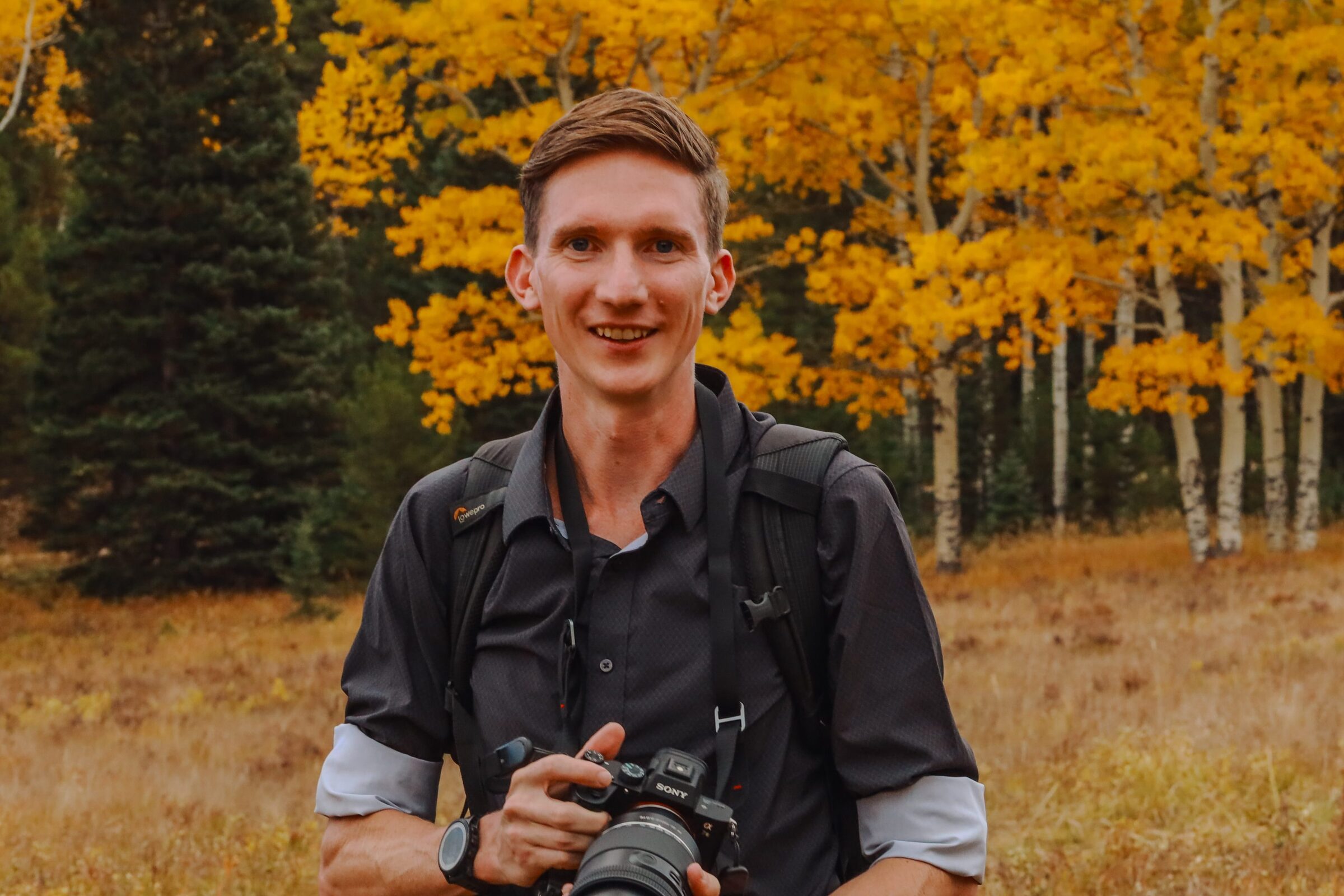 Brandon Krage is the filmmaker and owner of Motus Weddings, a husband-and-wife adventure wedding studio he runs with Aby from Colorado. He photographs and films weddings and elopements on digital, 35mm, Super 8mm, and 16mm cinema film, with Rocky Mountain National Park as home turf. More about Brandon and Aby.